
OET vs IELTS for Nurses in India: Which English Test is Better for Working Abroad?
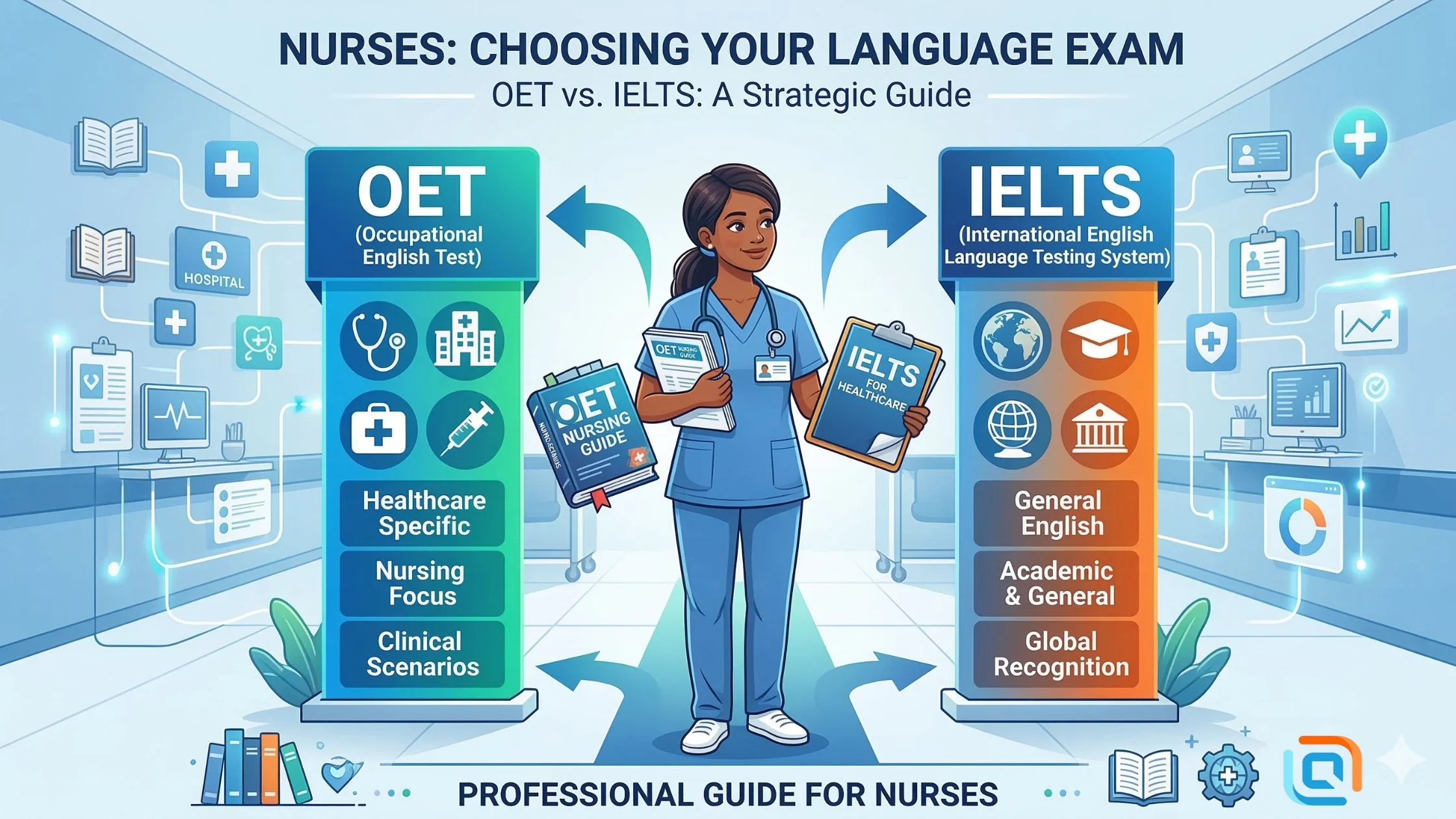
For thousands of nurses from India working in other countries is more than a job choice. It's an opportunity to gain career advancement, higher wages and exposure to modern healthcare systems. Countries such as that of United Kingdom, Australia, Ireland as well as New Zealand actively recruit skilled nurses from India every year.
But, prior to beginning a nursing career abroad, one of the main requirements must be met: proving English language proficiency.Many nurses have to answer a critical issue:
Do you need to take the OET test or the IELTS test?
Both tests are recognized worldwide and recognized by the nursing regulatory bodies in several nations. However, they differ in terms of format as well as their difficulty levels and importance to healthcare professionals.
In this article we'll look at the differences between IELTS and OET for nurses to help you decide which test is more suitable to meet your international nursing needs.
OET in comparison to IELTS: A Head-to-Head Comparison for nurses
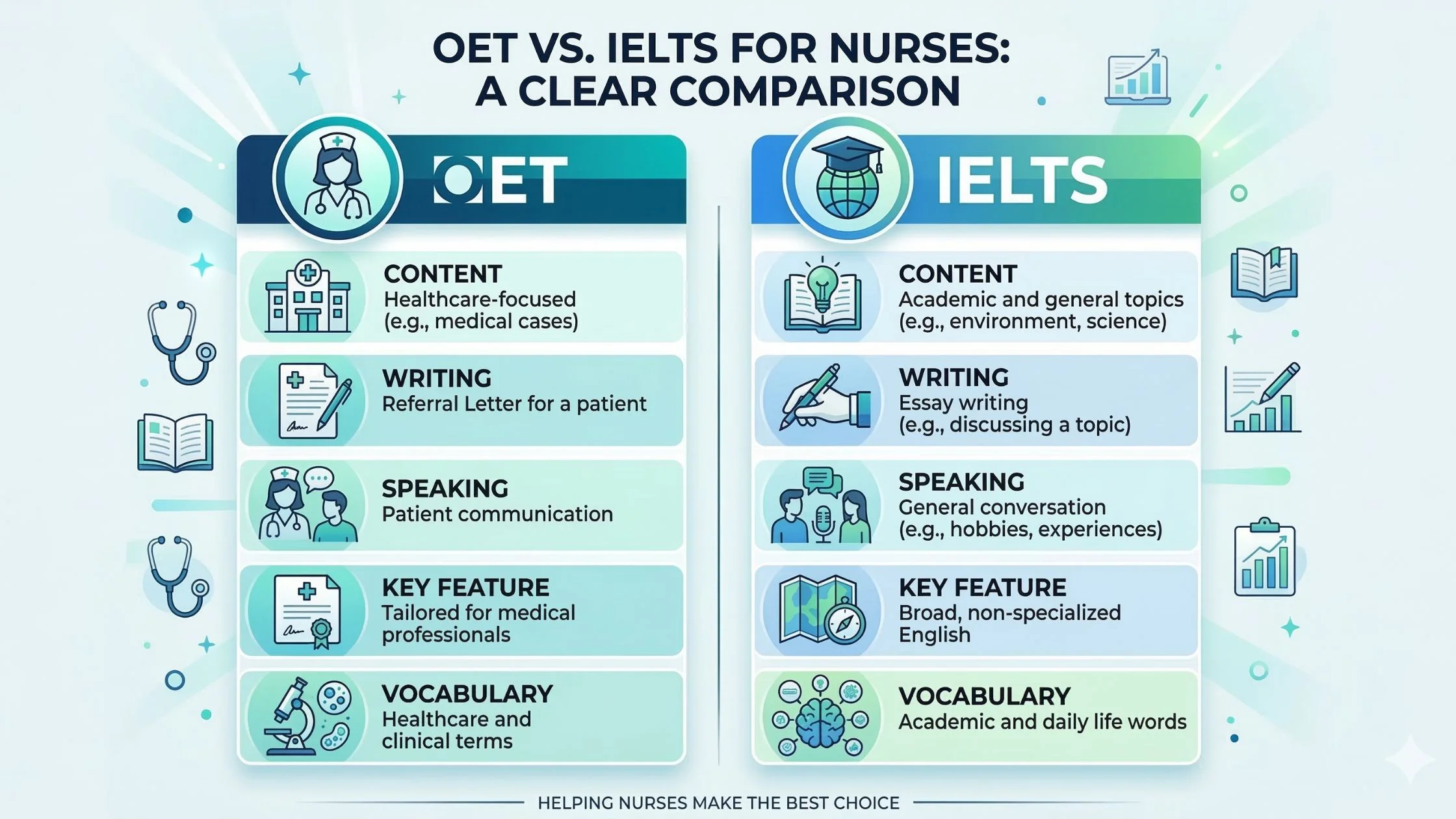
Although each of OET as well as IELTS are widely recognized and recognized however, they differ fundamentally in terms of their content and approach. Understanding the differences is essential in deciding which test best suits your professional strengths and background.
| Feature | Occupational English Test (OET) | International English Language Testing System (IELTS) |
|---|---|---|
| Primary Focus | Specially designed for healthcare professionals. Using real-world scenarios for clinical practice. | An academic and general English test designed to reach a large group of professionals and students. |
| Content | The entire course (Listening, reading, writing, and Speaking) are taught in an environment of health care. You could listen to a consultation with a patient and study an abstract of a medical journal and write a referral note or even role-play the handover of a patient. | The topics are varied and academic, from science and environment as well as art historical. The topic is not particular to any profession. |
| Perceived Difficulty | Many nurses discover that nurses find OET easier to understand and less daunting because it is a familiar subject as well as relevant for their job. | The complex and diverse subjects that are covered in IELTS may be difficult for students who aren't used to academic English even if they're fluent with conversational English. |
| Global Acceptance | The nursing boards are widely accepted within The UK (NMC), Australia (AHPRA), Ireland, New Zealand, and increasingly in the USA. | Accepted worldwide to be used for both academic and immigration reasons, including by the top nursing regulatory bodies across the globe. |
| Cost in India | Usually higher, around the range of Rs30,000 to Rs35,000. | The price is more affordable, generally between Rs17,000 and Rs18,000. |
What is the OET Exam for Nurses?
The Occupational English Test (OET) is an English proficiency test specially designed for healthcare professionals.
It is recognized by the nursing regulatory bodies of countries like:
- United Kingdom (NMC)
- Australia (AHPRA)
- Ireland
- New Zealand
- Singapore
- Dubai
In contrast to general English tests, OET focuses entirely on healthcare communication abilities.
This means that the test examines how nurses can communicate in actual situations in the clinical, for example:
- Explaining treatment options to patients
- Writing letters of recommendation
- Understanding medical discussions
- Communication with healthcare teams
Since the test content is directly connected to health care, nurses often are able to find OET to be more simple and efficient than IELTS.
The International English Language Testing System (IELTS)
The International English Language Testing System (IELTS) is one of the most well-known English test around the globe.
Nurses who are planning to work overseas typically opt for the IELTS Academic version.
The test consists of four sections:
- Listening
- Reading
- Writing
- Speaking
In contrast to OET, IELTS topics are not geared towards healthcare. The test may cover topics like:
- Environmental questions
- Education systems
- Social trends
- Technology
- The past or culture
Although IELTS assesses general English proficiency Many nurses believe that they are less pertinent to their particular profession.
OET vs IELTS: Section-by-Section Comparison

Understanding the way each test tests skills will help you decide on the most appropriate test.
| Section | OET | IELTS |
|---|---|---|
| Listening Test | The listening test contains health-related audio, for example: consultations with a doctor and patient, medical seminars, healthcare discussions. Nurses need to be aware of the most important medical details and comprehend the patient's information. | IELTS listening test covers diverse conversations for example: daily conversations, lectures on academic subjects, social interactions. Accents vary, and include British, Australian, or North American speakers. |
| Reading Test | OET readings focus on texts related to healthcare, such as: medical articles, hospital guidelines, notes from a clinical study. They are closely related to the materials for reading employed in healthcare areas. | IELTS reading passages are based on subjects in the field of education, including: science, technology, education, history. The vocabulary may be complicated and not related to healthcare. |
| Writing Test | For nurses, the OET writing assignment typically entails writing a reference letter, discharge letter, or transfer letter from patient notes. This test determines how nurses communicate patient information in professional medical records. | IELTS writing test is a two-part exam — Task 1: Explain graphs, charts or other processes; Task 2: Write an essay about a general subject. This requires academic writing proficiency. |
| Speaking Test | OET's speaking test comprises role-playing scenarios where the test-taker plays as a nurse, interacting with a relative or patient. This is assessed on: Empathy, Clarity, and patient communication. | Speaking on IELTS is a well-structured interview in which the examiner asks the candidate to discuss general topics like lifestyle, hobbies, and personal opinions. |
Which English Test is Better for Nurses?
For professionals in the field of healthcare for healthcare professionals, the OET test is typically the best option.
Here are a few reasons nurses pick OET:
- Healthcare-Focused Content: Each exam section is related to medical communication.
- Practical Communication Skills: The exam focuses on real-world workplace interactions, not the academic aspects.
- Familiar Vocabulary: Since the test employs medical terminology, nurses might be more comfortable with test's content.
But, IELTS could be an excellent choice if intend to take the test for:
- Immigration purposes
- Higher education
- More opportunities for professional growth
OET Score Requirements for Nurses Abroad

Different countries have different requirements for OET scores for nursing licenses.
| Country | Required OET Score |
|---|---|
| UK | A grade in every module |
| Australia | Grade B |
| Ireland | Grade B |
| New Zealand | Grade B |
A Grade B is an average of 350 in each section.
Salary of Nurses Abroad Compared to India
The choice to embark on an overseas nursing profession is usually motivated by the desire to have greater professional opportunities and greater earning potential. Indian nurses who are able to pass their English proficiency tests and get jobs abroad could see significant increases in their wages when compared to their domestic positions.
| Country | Average Annual Salary |
|---|---|
| India | Rs3 - Rs6 Lakhs |
| UK | Rs25 - Rs35 Lakhs |
| Australia | Rs33 - Rs44 Lakhs |
| Ireland | Rs30 - Rs40 Lakhs |
In addition to higher wages nurses working in other countries also get the following benefits:
- More comfortable working conditions for workers
- Modern medical technology
- International exposure
- Long-term career growth
How Nurses Can Prepare for OET or IELTS

A thorough preparation is crucial to the success of English proficiency tests. Here are some proven strategies for preparation.
- Understand the Exam Format: Before you begin your preparation, you should be familiar with the exam's structure as well as the scoring system and exam pattern.
- Improve Medical Vocabulary: To prepare for OET developing a solid medical vocabulary is beneficial in both writing and reading tasks.
- Practice Speaking Regularly: Speaking practice helps improve confidence and fluency in interviews or other situations.
- Take Mock Tests: Tests help you to recognize time management issues and weak points.
- Use AI-Based Learning Tools: Modern learning platforms employ artificial intelligence to analyse grammar, pronunciation, and speaking ability.
Speed Up Your Preparation For OET using Lanquill-Nursing
Making preparations for English proficiency tests can be a challenge, especially for healthcare professionals who are busy.
Lanquill Nursing is an artificial intelligence-powered learning platform that was created to assist nurses in improving their English communication skills effectively.
The platform offers instruction focusing on communication in the field of healthcare and OET training.
Key Features of Lanquill-Nursing
- AI-Powered Speech Analyzer: The system measures clarity, pronunciation and clarity in simulations of patient interactions.
- Healthcare-Specific Content: Over 700 hours worth of educational content that is based on real-life situations in healthcare.
- Smart Grammar and Vocabulary Builder: The latest tools assist nurses to improve their professional writing skills to write referral letters and discharge letters.
- Adaptive Reading System: Reading exercises automatically adjust the difficulty depending on the your performance.
- Real-Time Feedback: Rapid scoring and good feedback can help students track their progress in a timely manner.
- Affordable Learning: The cost of the course is only Rs600 for the year and is therefore accessible to nursing professionals and students.
Why Many Indian Nurses Prefer OET Over IELTS
Most nurses will find OET easier to study for due to the fact that the test is focused on their work environment.
Benefits include:
- Familiar medical terminology
- Realistic patient communication scenarios
- Profession-specific writing assignments
- Higher confidence during preparation
This focus on practical issues helps nurses improve their communication skills that they can use in healthcare settings that are international.
Frequently Asked Questions (FAQs)
Many nurses are able to pass OET simpler because the test is based on healthcare-related scenarios, not academic subjects.
They both OET as well as IELTS are recognized by nursing regulatory authorities in countries such as that of UK, Australia, Ireland as well as New Zealand.
Most states require an IELTS overall band score of 7, with any band score below 6.5.
OET scores are usually in effect over 2 years.
Yes. Successfully passing the OET test is among the most important requirements for nurses to be registered in many countries.
Final Verdict: OET or IELTS?
The two exams OET as well as IELTS are recognized internationally English proficiency tests that are internationally recognized. However, for professionals in the field of healthcare, OET is often the best option since it focuses on the real-world aspects of medical communication.
Nurses who plan to work overseas, choosing the appropriate exam can greatly influence preparation and confidence.
With the proper training with practice and the right tools getting the score you want is feasible.
Your journey to a world-class nursing career begins with solid communication skills and a well-planned preparation plan.
Related Articles

From Classroom to Career: How CEFR-Aligned English Courses Build Employability
In today’s globalized job market, strong English communication skills are no longer optional — they’re essential. Educational institutions play a crucial role in helping students bridge the gap between classroom learning and workplace communication.

How Modern English Language Labs Are Transforming Communication Skills in Classrooms
In today’s digital-first academic world, English language proficiency is no longer just a subject- it’s a critical life skill. While traditional spoken English classes have helped many learners, they often lack the structure, interactivity,

Why Educational Institutions Should Reevaluate Language Labs for Career Outcomes
In a country where millions graduate each year, one question continues to haunt both educators and employers — Are our students truly job-ready? While technical skills have seen significant improvement across colleges and universities, one area still lags behind: communication skills, particularly in English.

Top 7 Benefits of Using a Language Lab
Proficiency in English is now required in today's competitive academic and professional climate. Establishing a language lab is a wise investment for educational institutions looking to enhance their students' placement results and communication abilities.

Plagiarism: Why your writeup needs to be original
This isn't just another article that's going to list a ton of platitudes about why you shouldn't plagiarize. At Lanquill, we care about you at a deeper level. We're committed to understanding what drives you, what inhibits you, and enable you to overcome your obstacles.

The Apostrophe Conundrum
If you are a self-proclaimed Grammar Nazi, then the proper use of an apostrophe just might be your biggest pet peeve. From store marquees, city billboards, street signs to advertisements, showcase the terrible use, or rather misuse, of apostrophes.