
Best AI-Powered English Language Lab in India
Lanquill is an AI-powered English language lab built for Indian colleges, universities and higher-education institutions. It combines CEFR-aligned LSRWGV learning, real-time AI speaking and writing feedback, assessments, certifications and institutional analytics in a cloud-based platform that requires no dedicated language-lab hardware.
What is an English language lab?
An English language lab is a system for building listening, speaking, reading and writing (LSRW) skills through structured, technology-assisted practice. For decades that meant a physical room - networked PCs, headsets, a teacher console, locally installed courseware.
The purpose hasn't changed - far more speaking and listening practice than a lecture hall allows, done measurably. The delivery has. A lab no longer needs to be a room; cloud platforms deliver the same practice on any device, so a "lab" is shifting from a place to a system. AICTE also makes a language lab expected infrastructure for technical programmes - so nearly every campus has one, and what's inside varies widely.
What is an AI English language lab?
An AI English language lab does what traditional labs couldn't: give every learner instant, individual feedback on the skills hardest to assess at scale - speaking and writing.
Older labs let students record themselves, but nothing told them what to fix. An AI lab analyses pronunciation, fluency and writing automatically and returns feedback in seconds:
Beyond feedback, expect adaptive CEFR practice, a placement test, automated writing evaluation and cohort analytics. Lanquill covers LSRWGV - adding Grammar and Vocabulary - delivered from the cloud with no hardware to buy or maintain.
What are the best English language labs in India?
No lab is best for everyone - it depends on cloud vs on-campus, English-only vs multilingual, learning platform vs external exam. Ranked on AI feedback, CEFR alignment, analytics, India compliance and total cost, here's an honest shortlist.
Lanquill
Best for AI feedback, analytics and India-specific complianceCloud-first, English-focused. Real-time AI speaking and writing feedback, CEFR-aligned LSRWGV, cohort analytics, and mapping to AICTE-NEAT, NCrF Level 4 and SWAYAM Plus. No hardware; per-user pricing. Best where measurable outcomes and framework alignment matter more than a physical room.
Orell (Orell Talk)
Best for breadth and multilingual scaleLong-established, AI-enabled, CEFR-aligned, with a broad 7-in-one bundle and 25+ languages. Strong if you want one vendor across many languages and services. Detailed comparison below.
Traditional / on-campus labs
Best where connectivity is a genuine constraintInstalled hardware-plus-software labs still suit campuses where reliable internet or student devices can't be assumed. Trade-off: capped seats, maintenance, ageing content, weak analytics.
Cambridge (Linguaskill)
Best for external, globally recognised certificationNot a lab but often weighed alongside one: an AI-powered CEFR proficiency test and certification. Pairs with a learning platform rather than replacing it - full comparison below.
How much does an English language lab cost?
Cost depends on the model, and the two aren't comparable until you normalise them. A cloud per-user platform is billed per learner per year - Lanquill from ₹600 per user per year (ex-tax), stepping down by volume. A traditional build is one-time plus maintenance, commonly ₹8–15 lakh depending on seats and whether you reuse computers.
Compare over three years, divided by learners actually reached - a capped-seat lab reaches far fewer than its headline suggests. Full working, GST and funding routes are in the English language lab cost breakdown.
Traditional vs AI language lab
The difference isn't cosmetic. It changes what a student experiences and what an administrator can prove.
| AI Language Lab | Traditional Lab | |
|---|---|---|
| Speaking feedback | Instant, automated, per learner | Manual, teacher-dependent |
| Writing feedback | Automated evaluation | Rarely assessed at scale |
| Practice access | Anytime, any device | Timetabled slots in a room |
| Content updates | Continuous, centrally updated | Manual reinstalls; ages fast |
| Progress tracking | CEFR score movement, cohort analytics | Attendance and completion |
| Capacity | Whole cohort | Capped by seats |
| Cost shape | Per-user subscription | Capex + AMC + refresh |
For a deeper look at deployment and total cost, see on-premise vs cloud language labs.
What should colleges look for?
Most language-lab evaluations over-weight the demo and under-weight the things that decide whether the investment returns anything. Judge every option against these.
What administrators see - a representative cohort dashboard. Sample data, shown for illustration.
A language-lab evaluation checklist
- •Real speaking and writing feedback. Does the AI assess spontaneous output, or only multiple-choice and repeat-after-me drills?
- •CEFR alignment. Are levels and progress expressed on the A1–C2 scale an employer or university will recognise?
- •Cohort analytics. Can you pull activation, practice hours and score movement on demand - the evidence NAAC and NBA ask for?
- •Activation support. What share of provisioned learners actually log in, and what onboarding is included to lift it?
- •Compliance mapping. Does it map to AICTE, NEP, NCrF and credit frameworks, or only claim "global standards"?
- •Total cost over three years. Including maintenance, refresh and content updates - divided by learners actually reached.
- •Data you can export. Can you take your own outcome data out for your accreditation file, or is it locked in a dashboard?
The most predictive question is number four: a platform that reaches a third of your students costs three times its per-learner rate. Why that number decides everything is in how to track English improvement.
Is Lanquill CEFR aligned?
Yes. Lanquill's path and assessments align to the CEFR (A1–C2). A learner takes a placement test that fixes their level, follows a path calibrated to it, and sees progress on the same scale universities and employers use - with completion certified against it, not a vague "completed" badge.
Does Lanquill support NAAC, NEP and NCrF requirements?
This is where an India-built platform earns its place, and it's worth being precise rather than sweeping.
- NAAC- Assessors look for documented mechanisms that assess learning levels, support advanced and slow learners differently, use ICT-enabled tools genuinely, and evaluate outcome attainment. Lanquill's CEFR-level data, cohort analytics and intervention logs provide exactly that category of evidence.
- NEP 2020- The policy foregrounds communication skills and employability. A measurable, scalable English programme with outcome data speaks directly to those goals.
- NCrF- Lanquill is mapped to NCrF Level 4, which makes the learning eligible for credits under the Academic Bank of Credits - a concrete, credit-bearing outcome rather than a soft co-curricular add-on.
Lanquill also holds a SWAYAM Plus MoU (Ministry of Education) and an AICTE-NEAT listing. One honest caveat: a platform supplies the evidence — accreditation and credit outcomes remain the institution's own to earn and document.
How does Lanquill compare with Orell?
Orell is the closest peer: both are AI-enabled, CEFR-aligned labs sold to Indian institutions, and both do the core job well. The differences are focus and shape.
| Lanquill | Orell | |
|---|---|---|
| Category | Cloud-first English lab | Established suite (offline / online / hybrid) |
| AI feedback | Speaking + writing | AI voice assistant; speaking-led |
| Breadth | Focused on English outcomes | Broad 7-in-one bundle; 25+ languages |
| Analytics | Cohort outcome analytics | Engagement & assessment tracking |
| India compliance | AICTE-NEAT, NCrF L4, SWAYAM Plus | CEFR / global proficiency framing |
| Hardware | None - cloud, any device | Integrates with campus infrastructure |
Choose Orell for many languages and a wide service bundle (teacher training, digital library, career lab), or a long-established name with offline options. Choose Lanquill for measurable English outcomes, AI feedback on speaking and writing, and Indian compliance mapping - with no hardware to run.
How does Lanquill compare with Cambridge?
Often requested, usually misframed - they're not the same kind of product. Cambridge's Linguaskill is an AI-powered, computer-adaptive CEFR proficiency test that certifies a learner's level across reading, listening, writing and speaking, recognised worldwide. It's assessment and certification, not a learning platform.
| Lanquill | Cambridge (Linguaskill) | |
|---|---|---|
| Primary purpose | Develop & measure English | Test & certify English |
| Daily learning | Structured practice + AI feedback | Not a learning platform |
| Certification | CEFR-aligned, internal | Globally recognised, external |
| Analytics | Ongoing cohort progress | Point-in-time test results |
| Best used as | The learning engine | The external benchmark exam |
They're complementary, not rivals: use a learning platform like Lanquill to build and track proficiency across a semester, and a Cambridge exam to certify it externally. Need only a branded certificate for admissions? Cambridge. Need students to actually improve, with feedback and analytics? That's the lab.
How does Lanquill compare with traditional language labs?
Against a conventional on-campus lab, the difference beyond the table above comes down to reach and evidence per rupee.
A fixed room serves only the students who fit timetabled slots; a cloud platform reaches the whole cohort on devices they own. One reports attendance; the other reports CEFR movement you can defend in an audit. A traditional lab carries capex, maintenance and a refresh cycle - Lanquill carries none. The one exception is genuinely poor connectivity, where a hybrid approach wins.
The bottom line
The "best" English language lab isn't the one with the most features or the longest heritage - it's the one that reaches all your students, gives them real feedback, and produces evidence you can put in front of an accreditation team. Evaluate against that, not against the demo.
Frequently Asked Questions
An English language lab is a dedicated system for developing students' listening, speaking, reading and writing skills through structured, technology-assisted practice. Traditionally it was a physical room of networked computers with headsets and a teacher console. Modern labs are increasingly cloud-based platforms that deliver the same structured practice on any device, without a dedicated room.
An AI English language lab uses artificial intelligence to give each learner instant, individualised feedback - most importantly on speaking and writing, which older labs could not assess automatically. It typically includes AI pronunciation and fluency scoring, adaptive practice mapped to CEFR levels, automated writing evaluation, and analytics that show administrators how a whole cohort is progressing.
It depends on the model. A cloud per-user platform is billed per learner per year - Lanquill starts at ₹600 per user per year, exclusive of taxes, with volume tiers. A traditional on-campus lab is a one-time system cost plus annual maintenance, commonly ₹8–15 lakh for a full build depending on seat count and whether computers already exist. Compare on a three-year, per-learner-reached basis.
Yes. Lanquill's learning path and assessments are aligned to the Common European Framework of Reference (CEFR), spanning A1 to C2, so a learner's level and progress are expressed on an internationally understood scale and completion is certified against it.
Lanquill provides the measurable outcome data, CEFR-level tracking and ICT-enabled learning that support NAAC evidence and NEP 2020's communication-skill goals, and it is mapped to NCrF Level 4, which makes learning eligible for credits under the Academic Bank of Credits. It supports these requirements with data; accreditation outcomes remain the institution's own.
Both are AI-enabled, CEFR-aligned language labs. Orell is an established suite with a long heritage, a broad 7-in-one bundle and support for 25+ languages. Lanquill is a cloud-first, English-focused platform that emphasises AI speaking and writing feedback, institutional analytics, India-specific compliance mapping (AICTE-NEAT, NCrF Level 4, SWAYAM Plus) and per-user pricing with no lab hardware.
They are different categories. Cambridge, through Linguaskill, provides a globally recognised, AI-powered English proficiency test and certification. Lanquill is a learning and practice platform that develops and measures English through structured daily use. Cambridge certifies proficiency externally; Lanquill builds it and tracks it internally. Many institutions use a learning platform for development and a Cambridge exam for external certification.
See it on your own cohort
We'll walk your academic and IQAC teams through Lanquill on a live dashboard - CEFR progression, cohort analytics and the compliance mapping - and run any competing quote through the three-year, per-learner comparison alongside ours.
Related Articles
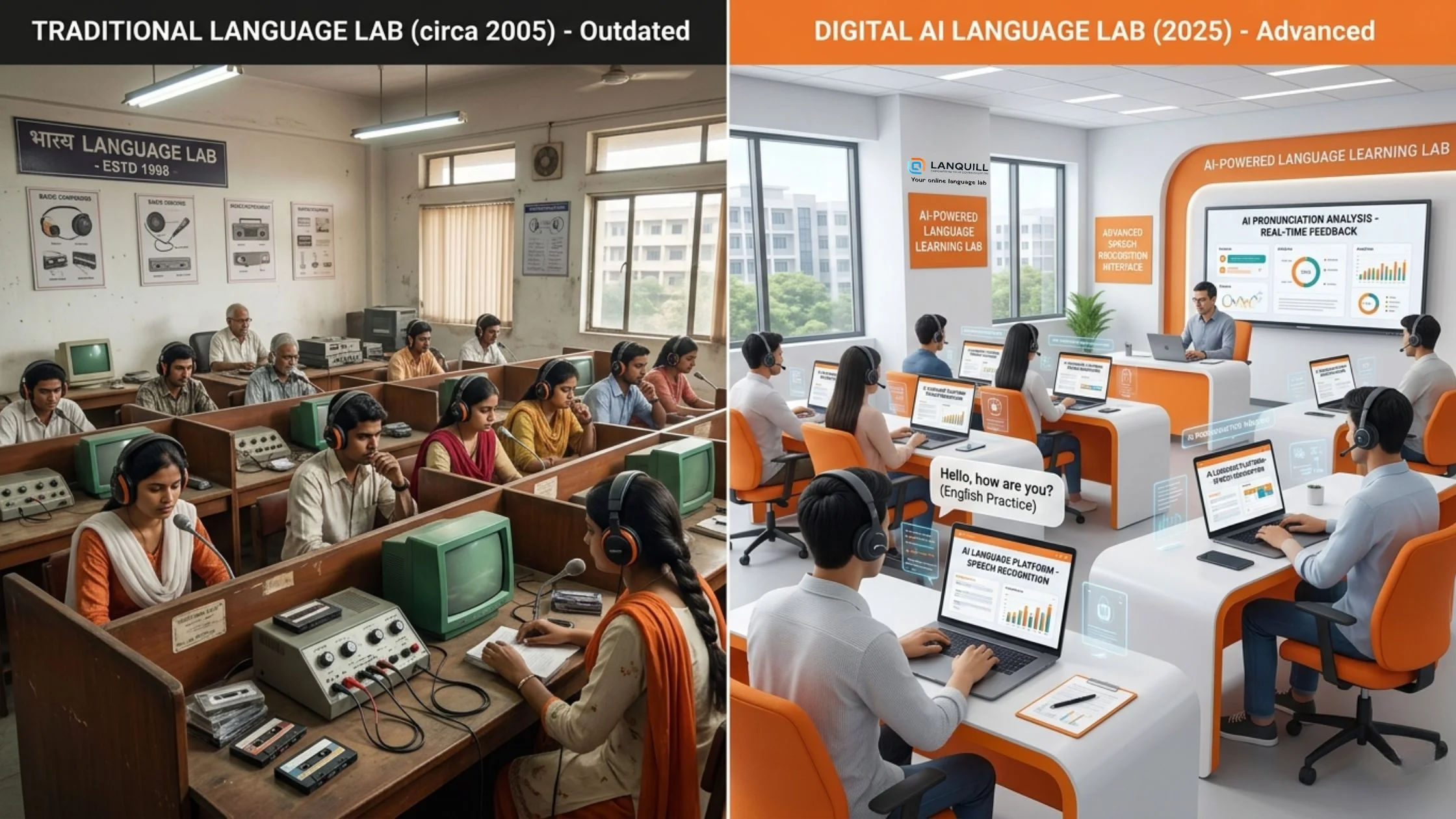
Traditional vs Digital Language Labs for Colleges (2026 Guide)
Compare traditional vs digital language labs and discover which is better for colleges to improve communication skills and placement outcomes.
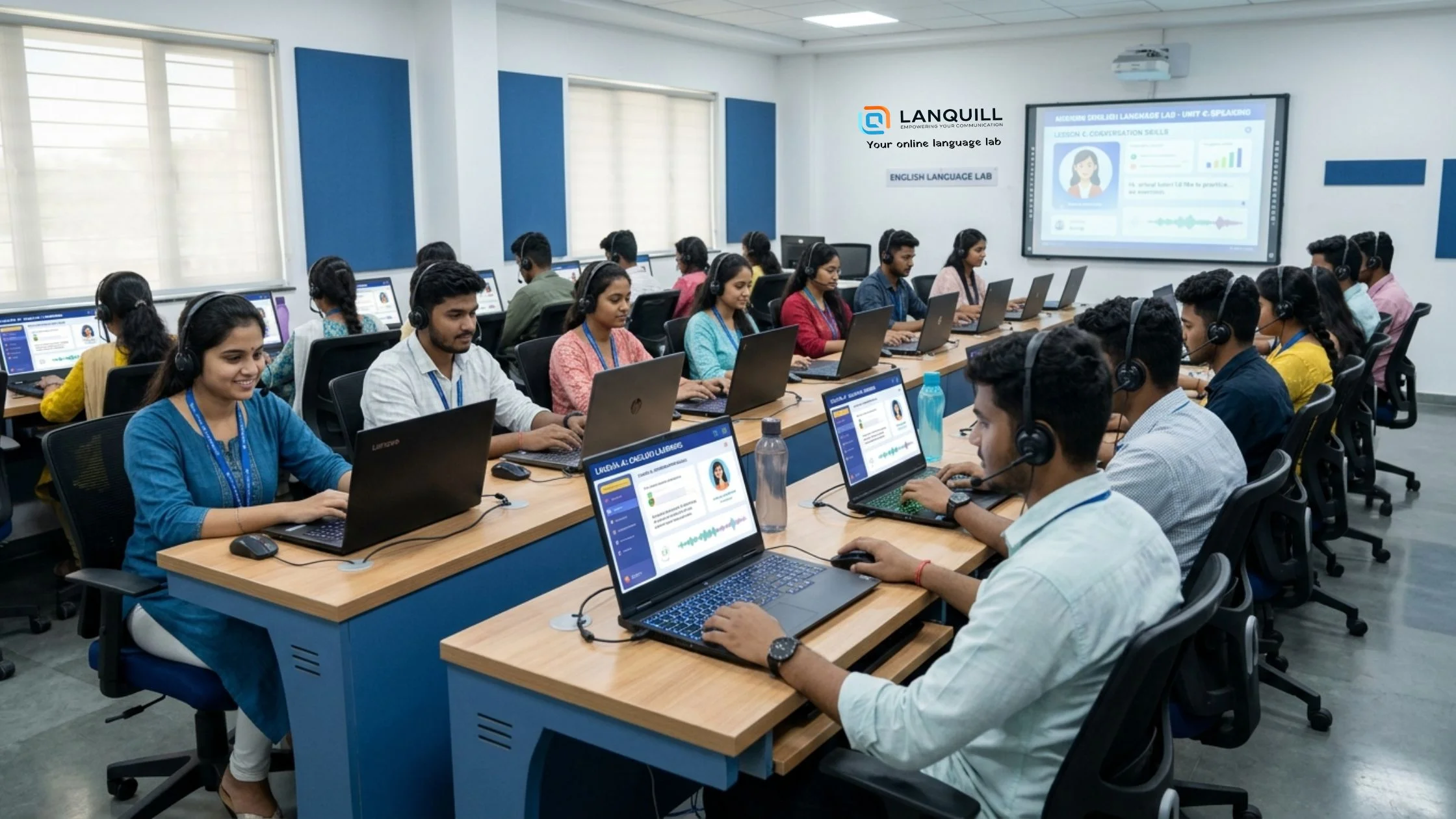
What is an English Language Lab for Colleges? Benefits Explained
Learn what an English language lab for colleges is and how it improves communication skills, placement readiness, and student outcomes.
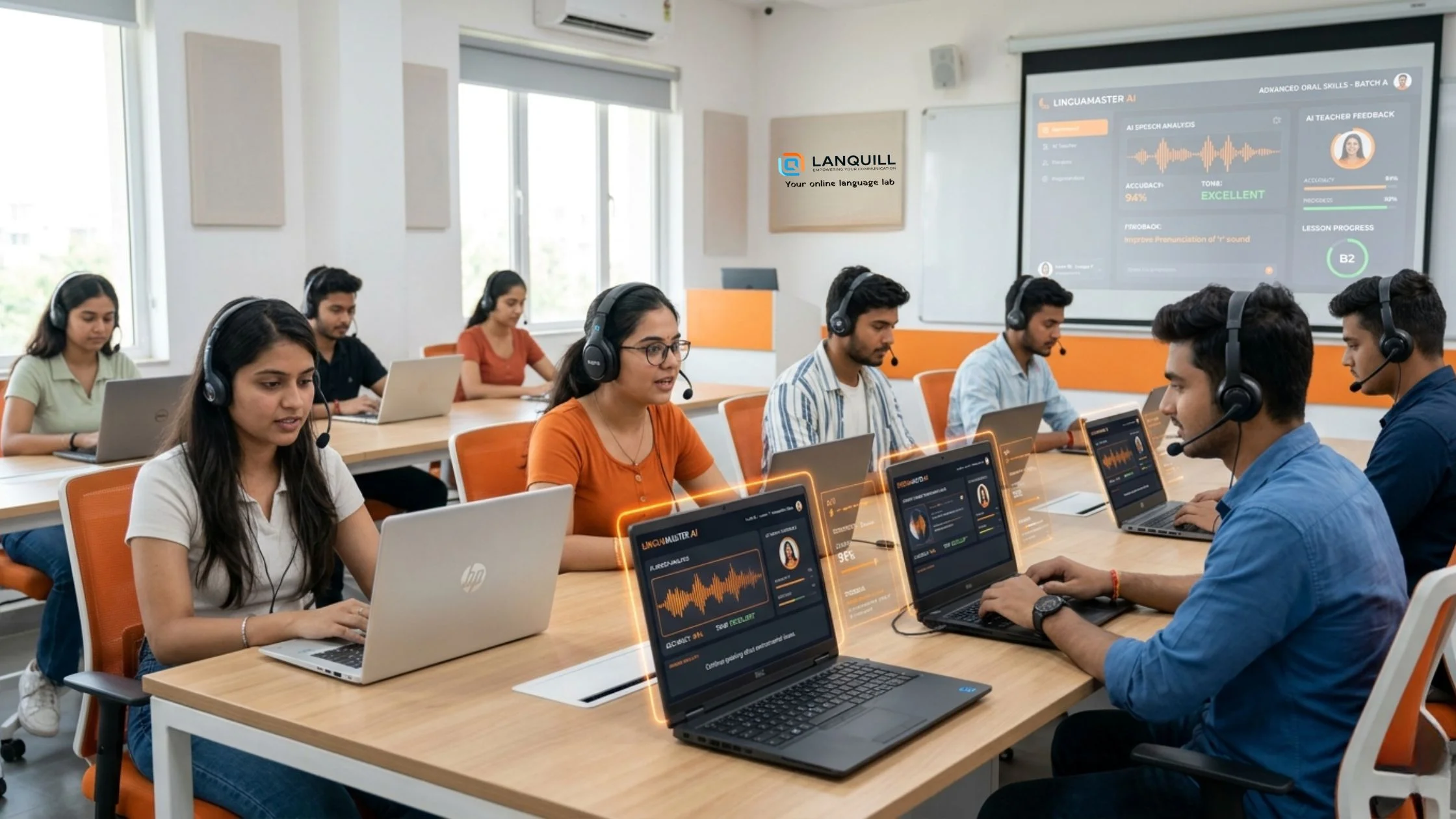
Why Every College Needs an AI Language Lab in 2026
Discover why every college needs an AI language lab in 2026 to improve student communication and placement readiness.

From Classroom to Career: How CEFR-Aligned English Courses Build Employability
Learn how CEFR-aligned English courses improve workplace communication and career readiness.

How Modern English Language Labs Are Transforming Communication Skills in Classrooms
Explore how modern language labs improve communication skills using technology.
English Spoken Classes vs English Language Lab: Key Differences You Should Know
Compare spoken English classes and language labs to understand their approaches and outcomes.