
10 Best Spoken English Courses Online in India (2026)
Ten platforms compared honestly - by how much you actually speak, how structured the learning is, whether you get feedback, and whether you finish with something to show for it.
"Spoken English course online" returns hundreds of options in India, and almost all of them claim to be the best. Most comparisons don't tell you the one thing that decides your result: how many minutes you'll actually spend speaking, and whether anyone corrects you when you do.
This guide ranks ten of the most credible options for 2026 against that standard. Each entry states who it genuinely suits and where it falls short, so you can match a platform to your goal rather than to its marketing.
How we ranked · and a disclosure
This guide is published by Lanquill, which makes an English-speaking programme and appears at number one. We've been open about that, described every other platform accurately, and included honest limitations for each - including our own. No star ratings or review counts are invented anywhere on this page.
We ranked for the learner who wants to measurably speak better, weighting four things: real speaking practice with feedback, structure and progression, a measurable outcome or certificate, and value you can sustain over months. A platform built for casual daily chat will rank differently here than in a guide ranking purely on price - so read the "best for" line on each, not just the number.
Quick picks by goal
The 10 best spoken English courses online in India
Lanquill
Best overall for structured, measurable speaking + a certificateLanquill is built around the gap most tools ignore: turning practice into measurable progress. You get AI-led speaking practice with automated pronunciation and fluency feedback, a placement test that fixes your starting CEFR level, a structured path rather than random chat, and a score you can watch move - finishing with a CEFR-aligned certificate. Its credibility comes from institutional use: the same platform runs at campuses including IIT Madras, IIT Kharagpur and NIT Manipur, so the pedagogy is built for measurable outcomes, not engagement metrics. That makes it the strongest fit for learners preparing for placements, higher study or any goal where you need to prove your level, not just feel more confident.
Strengths
- Speaking practice with automated feedback
- Structured, level-based progression
- Measurable score + CEFR-aligned certificate
- Practise anytime on your own device
Consider
- A structured programme, not drop-in casual chat
- Heritage is institutional; best if you want rigour
- Human 1-on-1 conversation is not the core format
EngVarta
Best for daily live 1-on-1 practice with a humanEngVarta is the platform most associated with this search in India, and deservedly so. You open the app, connect within a couple of minutes to a trained English expert, and hold a real audio conversation with live correction and a short feedback note at the end. The audio-only format removes the camera anxiety that stops many learners from practising. It's the best pick if what you lack is simply reps - daily, low-pressure speaking with a person who corrects you.
Strengths
- 100% live speaking with trained experts
- Audio-only removes camera anxiety
- Built for Indian learners; affordable per session
Consider
- Conversation practice, not a structured syllabus
- No formal certificate on completion
- Progress isn't scored against a framework
Cambly
Best for practising with native speakersCambly connects you on demand to native English speakers for video or audio conversation. If your goal is exposure to natural accents and idiom - useful for study abroad or roles with international teams - it's a strong choice. It sits at the premium end, and like most conversation platforms it's practice rather than a curriculum.
Strengths
- On-demand access to native speakers
- Natural accents, idiom and real conversation
- Flexible, no fixed batches
Consider
- Premium pricing per minute
- Tutor quality varies
- Little structure or measured progression
Preply
Best for choosing your own tutorPreply is a marketplace: you browse tutors by price, specialism and reviews, then book 1-on-1 lessons. The range is huge - from budget conversation partners to exam-prep specialists - which is its strength and its catch, since the experience depends entirely on the tutor you pick. Good for learners who want a consistent coach and are willing to trial a few first.
Strengths
- Wide choice of tutors and price points
- Can specialise: interviews, IELTS, business
- Build a relationship with one coach
Consider
- Quality depends heavily on tutor choice
- Trial-and-error to find the right fit
- No standardised curriculum or certificate
Italki
Best for affordable tutor varietyItalki is a large global tutor marketplace, similar in model to Preply but often cheaper, with a mix of professional teachers and informal "community tutors." Excellent value if you're comfortable driving your own learning and just want frequent, affordable speaking time with a real person.
Strengths
- Large pool of tutors worldwide
- Community tutors keep costs low
- Flexible scheduling across time zones
Consider
- You set your own structure
- Variable teaching quality
- No formal certification path
British Council English Online
Best for a globally recognised curriculumThe British Council offers structured online courses with certified teachers and a curriculum recognised worldwide. If a respected name on your certificate matters and you want a proper syllabus rather than open conversation, it's a dependable, if more expensive, choice. Live speaking time is typically in group classes rather than 1-on-1.
Strengths
- Structured, recognised curriculum
- Qualified teachers and certification
- Strong for exam preparation
Consider
- Higher subscription cost
- Speaking often in group, not 1-on-1
- Less flexible than on-demand apps
ELSA Speak
Best for pronunciation and accentELSA is an AI app focused narrowly and well on pronunciation. It listens to how you say words and gives instant, precise feedback on sounds you're getting wrong - genuinely useful for reducing mother-tongue influence. It won't build conversational fluency on its own, so it works best as a companion to a conversation platform.
Strengths
- Precise, instant pronunciation feedback
- Excellent for accent and specific sounds
- Practise privately, any time
Consider
- Narrow focus - pronunciation only
- No real conversation or curriculum
- Best used alongside another tool
Speak
Best for AI conversation without a humanSpeak is an AI-conversation app that lets you talk to a voice tutor and get feedback without booking a person. It's improved sharply and suits learners too self-conscious to start with a human, or who want unlimited low-stakes reps. The trade-off is that AI conversation, however good, isn't yet a full substitute for a person responding to what you actually meant.
Strengths
- Unlimited practice, no booking
- No social pressure to start speaking
- Instant feedback
Consider
- Not a substitute for human nuance
- Limited real-world unpredictability
- No recognised certificate
Duolingo
Best free foundation and daily habitDuolingo is the most popular language app in the world and genuinely free. It's excellent at building vocabulary and a daily habit for beginners. Be clear-eyed about one thing, though: it isn't really a spoken English course. Its speaking exercises are limited to repeating short phrases, with no spontaneous conversation and no correction of your own speech.
Strengths
- Free; strong habit-building
- Great vocabulary foundation for beginners
- Gamified and easy to stick with
Consider
- Not a true speaking course
- No spontaneous conversation or correction
- Won't build fluency alone
Hello English
Best free India-built beginner appHello English is a popular India-built app with a free tier, teaching English through your own first language - helpful for genuine beginners who find English-only apps intimidating. Like other self-paced apps, it builds foundations rather than conversational fluency, so treat it as a starting point rather than a finishing one.
Strengths
- Free tier; built for Indian learners
- Teaches via your first language
- Good for absolute beginners
Consider
- Foundation, not fluency
- Limited real speaking practice
- No certification
How to choose the right one for you
Cost matters, but not the way most people compare it. A ₹40-per-minute native tutor you see twice a month costs more per speaking minute than a low-cost app you use daily - and it's the daily reps that build fluency. Judge every option by the speaking practice you'll realistically sustain, not the headline price.
The rule that decides your result
Fifteen minutes of speaking every day beats a ninety-minute class once a week. Whatever you choose, pick the one you'll actually open daily - consistency outperforms intensity in every serious study of language learning.
Then match the format to your goal. Want a recognised outcome for a CV or placement file? Choose a structured, certificated programme. Just need reps with a person? A live conversation app. Fixing your accent? An AI pronunciation tool alongside it. Many successful learners pair a free app for foundation with one paid speaking layer on top.
If a measurable result and a certificate are what you're after, that's exactly what Lanquill's English speaking course with certificate is built to deliver. For the study habits that make any of these work, see our guide to learning English fast, and to practise reading alongside speaking.
Frequently Asked Questions
There's no single best for everyone. For structured, measurable improvement with a certificate, a programme-based platform like Lanquill suits placement and academic goals. For cheap daily human practice, EngVarta. For native speakers, Cambly. For your own tutor, Preply or italki. Match the platform to your goal.
If a recognised certificate matters for a CV or placement file, choose a course built around a proficiency framework rather than a casual app. Lanquill issues a CEFR-aligned certificate on completion, and British Council programmes are certificated. Most conversation apps and tutor marketplaces don't provide one.
Free apps like Duolingo and Hello English build vocabulary and habit well, but rarely build conversational fluency alone, because fluency needs speech produced under pressure with correction. Most learners do best pairing a free app for foundation with a live or AI-feedback platform for speaking.
Prices span a wide range: free apps with optional subscriptions of roughly ₹100–150 a month; daily-practice apps in the low hundreds per session; native-speaker and premium tutors considerably higher per hour; structured programmes billed per course or per year. Judge by price per speaking minute you can sustain.
Moving up one CEFR level typically takes 100–200 guided learning hours, per Cambridge English, growing at higher levels. With daily practice, many intermediate learners see meaningful improvement within four to six weeks, though professional working proficiency takes several hundred hours in total.
Want the one that measures your progress?
Lanquill gives you a placement test, structured speaking practice with automated feedback, a progress score you can watch move, and a CEFR-aligned certificate at the end - the outcome most conversation apps can't give you.
Related Articles
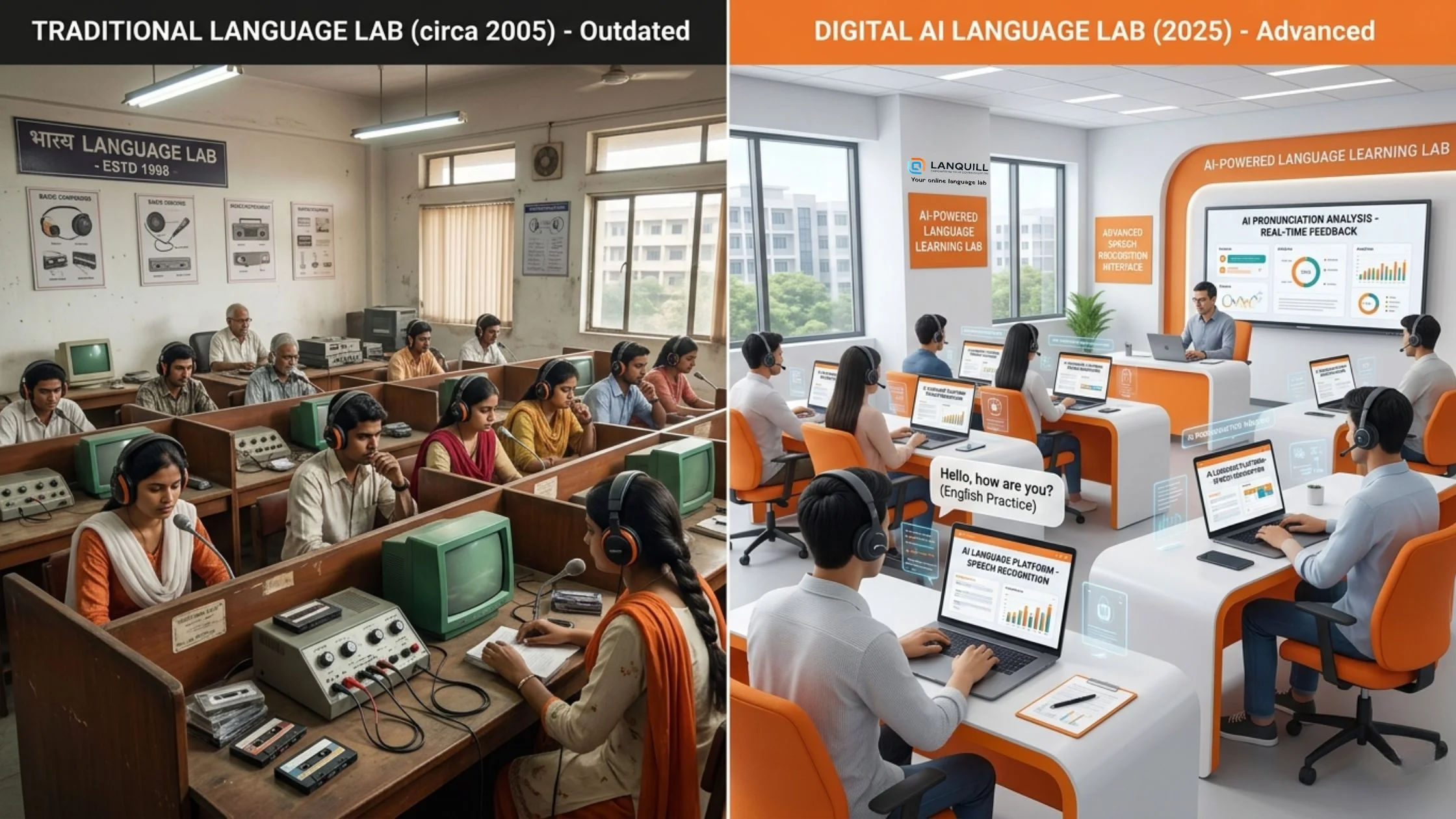
Traditional vs Digital Language Labs for Colleges (2026 Guide)
Compare traditional vs digital language labs and discover which is better for colleges to improve communication skills and placement outcomes.

What is an English Language Lab for Colleges? Benefits Explained
Learn what an English language lab for colleges is and how it improves communication skills, placement readiness, and student outcomes.
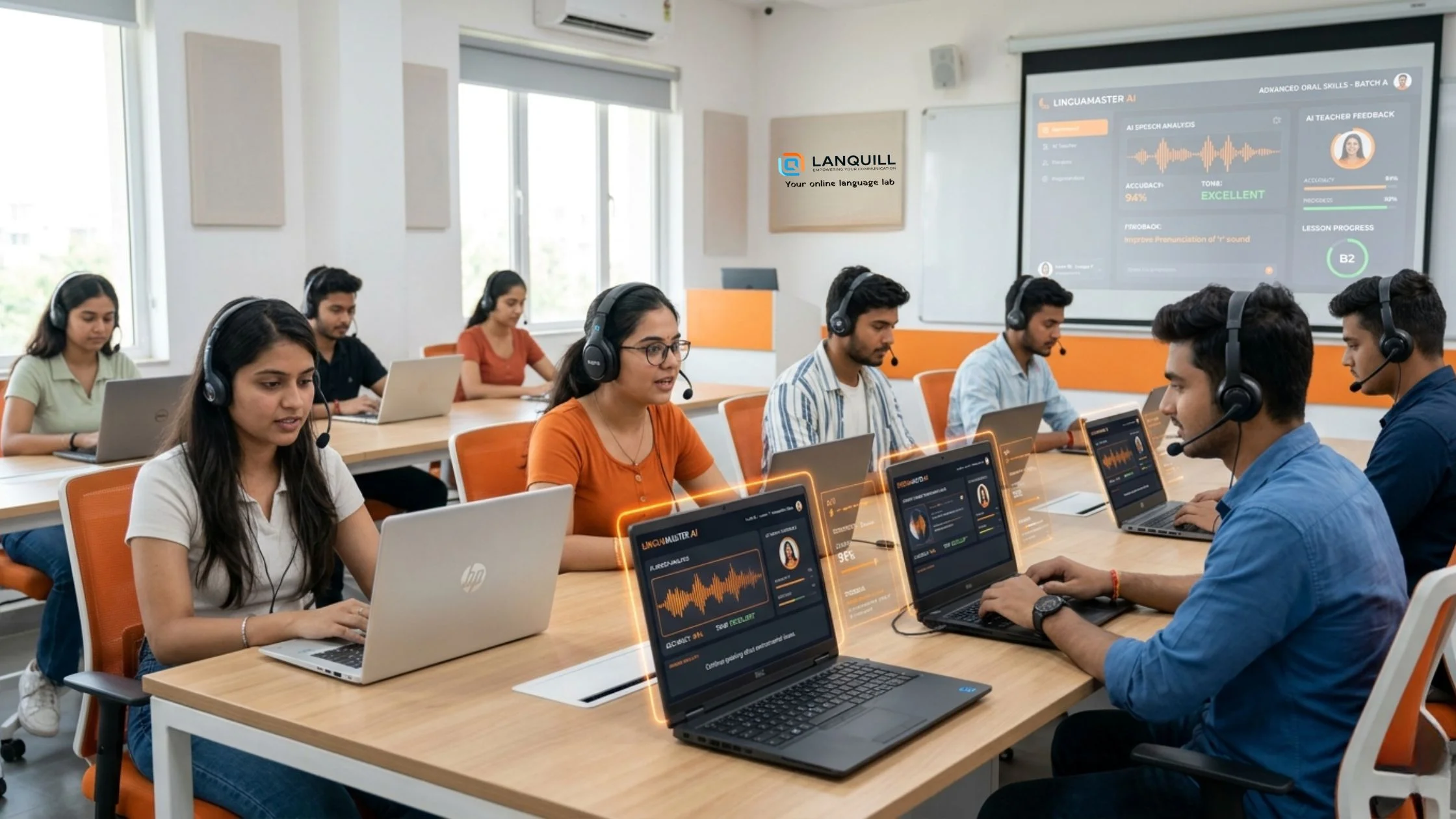
Why Every College Needs an AI Language Lab in 2026
Discover why every college needs an AI language lab in 2026 to improve student communication and placement readiness.

From Classroom to Career: How CEFR-Aligned English Courses Build Employability
Learn how CEFR-aligned English courses improve workplace communication and career readiness.

How Modern English Language Labs Are Transforming Communication Skills in Classrooms
Explore how modern language labs improve communication skills using technology.
English Spoken Classes vs English Language Lab: Key Differences You Should Know
Compare spoken English classes and language labs to understand their approaches and outcomes.